ASO Trends 2026: How to Rank Your App With Semantic ASO
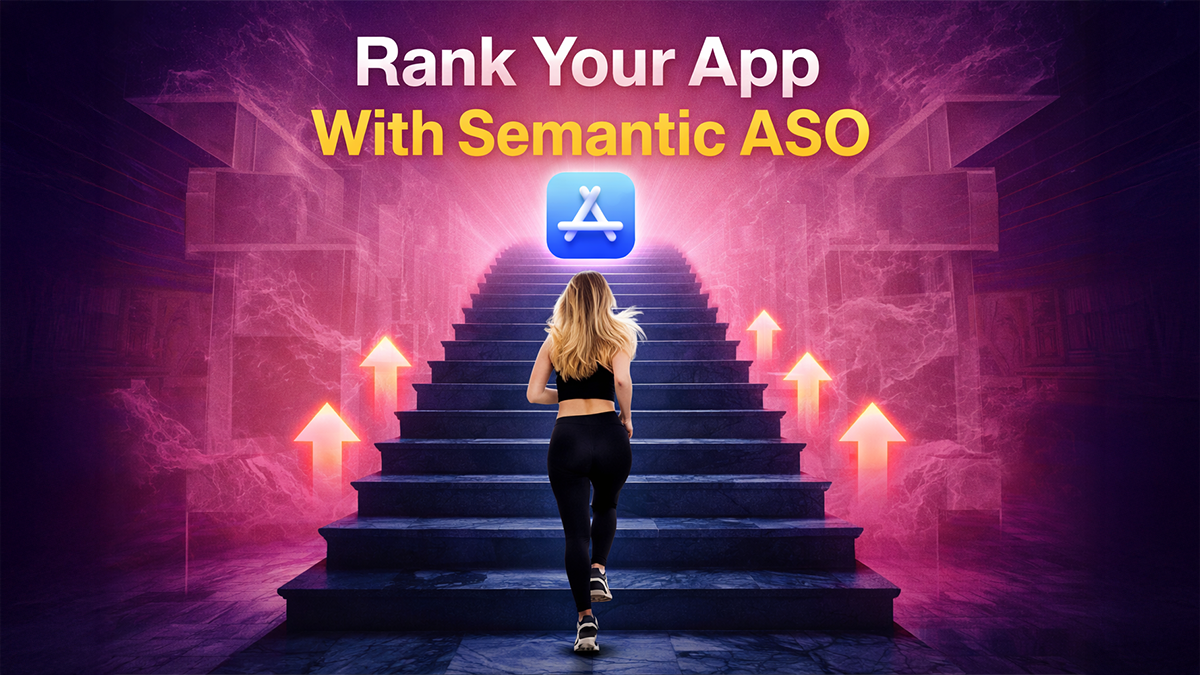
Top rankings in 2026 aren’t won by “adding more keywords.”
They’re won by being the best match for a user’s intent.
And that match is now semantic.
Meaning:
If your page sounds right, looks right, and delivers fast…
you climb.
If it doesn’t…
your growth caps, even with a great product.
Let’s break down what changed, what to fix, and the exact sequence that actually works.
Keyword ASO vs Semantic ASO (what changed in 2026)
Keyword ASO is old-school matching.
User searches: “habit tracker”
You try to rank by stuffing: habit, habits, tracker, tracking, daily habits…
Semantic ASO is newer matching.
The store tries to understand:
what the user really wants, and whether your page proves it.
So the match is no longer “does your listing contain the word?”
It’s: “Does this app look like the right solution for this intent?”
This shift has been discussed heavily in 2026 ASO trend reports, especially the move from pure keyword matching to semantic matching and intent-based relevance.
And it changes the game because…
Traffic doesn’t fix mismatch. It exposes it.
The hidden mechanism behind semantic rankings
Here’s the part most founders miss:
Semantic ASO isn’t just about discovery.
It’s about momentum.
Because stores don’t want to rank apps that get installs… then disappoint users.
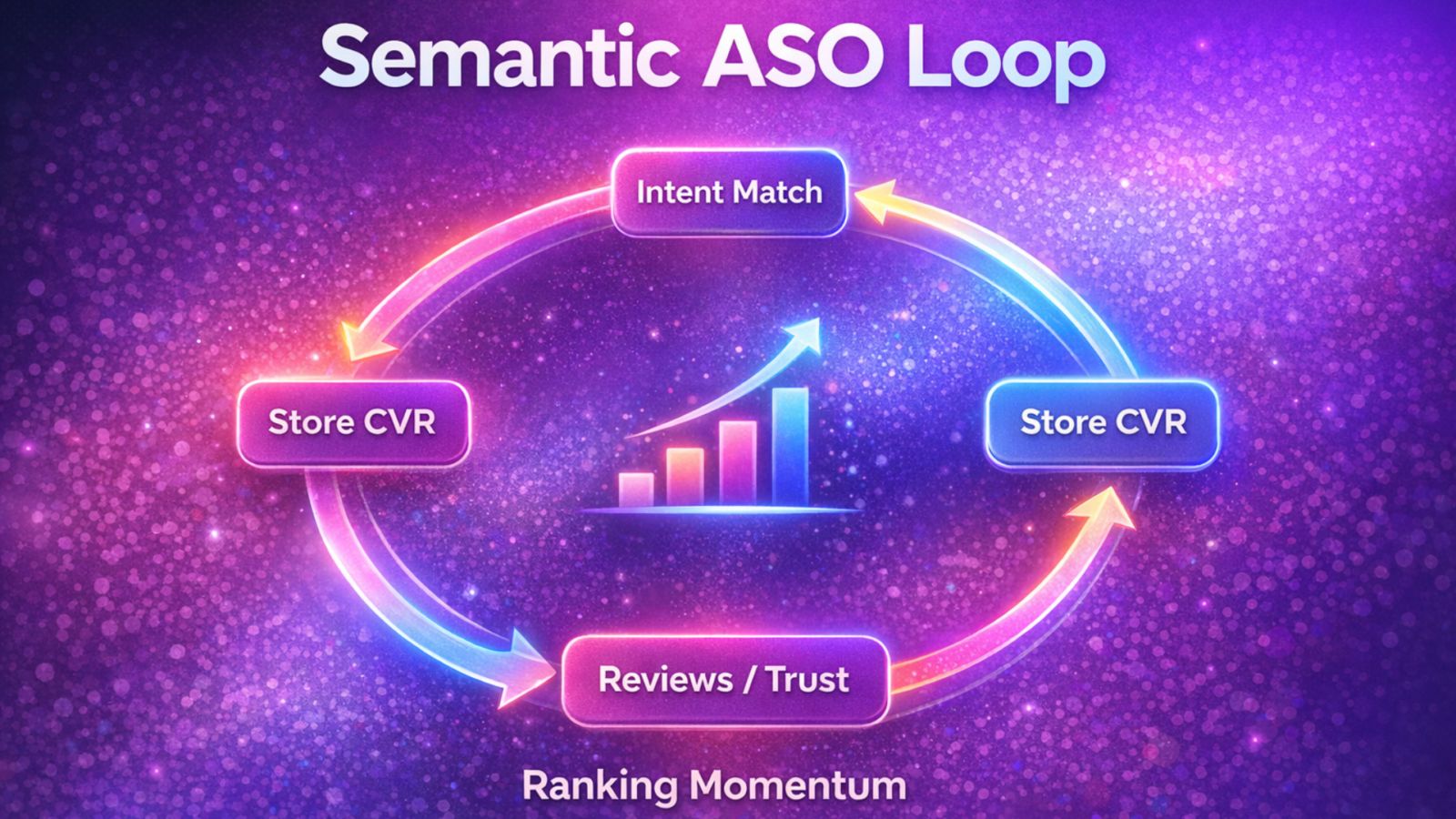
So your “ranking strength” becomes a loop:
✅ Match the intent → ✅ convert the visit → ✅ deliver a first win → ✅ earn safety signals → ✅ rank higher
When you break the loop, the store learns fast:
-
users bounce
-
users don’t engage
-
users leave reviews mentioning paywalls/bugs/confusion
-
conversion drops
-
your ranking stalls
This is why some apps feel like they “hit a ceiling.”
They didn’t hit a keyword ceiling.
They hit a belief ceiling.
60-second diagnostic: Semantic ASO Readiness Score
Open your store page right now.
Score yourself honestly.
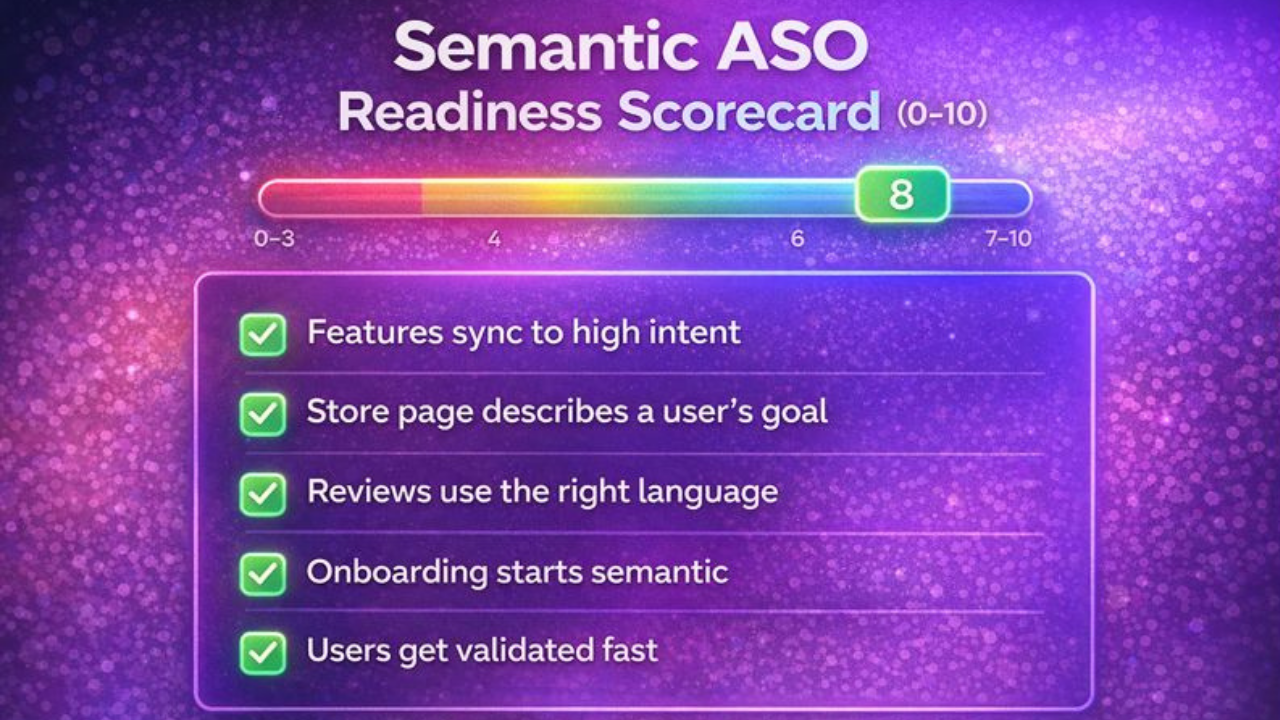
✅ Semantic ASO Readiness Score (0–10)
Give yourself 1 point for each “yes”:
-
Your first screenshot communicates an outcome, not a feature
-
A user understands who it’s for in under 3 seconds
-
Your screenshots follow a story, not a gallery
-
You show at least one piece of proof early (not buried)
-
Your page reduces “paywall fear” with a clear safety signal
-
Your preview video (if you have one) matches the exact promise
-
Your “first win” happens in the first minute of using the app
-
Your store promise and onboarding are the same narrative
-
Your reviews don’t scream bugs / traps / confusion
-
Your page would still convert even if the user never reads the description
0–4: semantic mismatch (ranking is fragile)
5–7: you can climb, but you won’t hold
8–10: you can scale discovery without collapsing conversion
Now let’s fix it.
The fix plan (what to change first, second, third)
This is where most teams waste months.
They redesign everything. They rewrite everything.
They change icons, colors, descriptions, “branding.”
And nothing moves.
Semantic ASO is not a redesign problem.
It’s a sequencing problem.
Here’s the order that wins.
Step 1: Rebuild your “intent map”
Your goal is not to rank for “keywords.”
Your goal is to rank for intent clusters.
An intent cluster is the real job the user is hiring the app to do.
Examples:
-
“I want habits” ❌ (category)
-
“I want to stop quitting after 3 days” ✅ (intent)
-
“I want budget tracking” ❌ (category)
-
“I want to stop wondering where my money went” ✅ (intent)
Build 3 intent clusters max.
Not 12.
Not “everyone.”
Just 3 strong matches you can dominate.
🧠 The Intent Triangle (simple but deadly effective)
For each cluster, define:
-
Trigger moment: what happened before they searched?
-
Desired outcome: what do they want to feel after?
-
Risk fear: what stops them from installing?
If you do this, your page becomes relevant without forcing it.
If you want a full library of frameworks like this, start here:
https://growthlaunch.net/learn-app-marketing-expert-tips-aso-guides-growth-strategies/
Step 2: Rewrite your screenshots as meaning, not UI
In 2026, screenshots are less “visuals.”
They’re your semantic payload.
They tell the store algorithm and the user:
✅ what this app means
✅ who it is for
✅ why it’s safe
Your first screenshot is not a feature. It’s a decision headline.
If your first screenshot says:
-
“Track habits”
-
“Organize tasks”
-
“Plan workouts”
…you’re not differentiating.
You’re labeling the category.
That caps conversion.
Step 3: Align first-session “proof” with the store promise
Most apps lose semantic strength here:
They promise an outcome… Then the first session feels like setup work.
That creates regret. And regret kills momentum.
So you want this alignment:
Store promise: “Get a plan in 10 seconds.”
First session: plan appears in 10 seconds.
Store promise: “No spreadsheets.”
First session: insight appears instantly.
This is why installs ≠ growth.
If you want the deeper organic side of it, this is relevant:
https://growthlaunch.net/organic-growth-aso-in-2025-how-to-boost-app-installs-without-spending-a-dime/
Step 4: Test with native tools (PPO / Experiments)
Semantic ASO is not theory. It’s testable.
Run experiments the right way:
Your first tests should not be “icon vs icon.”
They should be meaning tests:
🔥 Test #1: Screenshot 1 headline (outcome framing)
🔥 Test #2: Screenshot order (belief sequence)
🔥 Test #3: Risk reducer line (safety signal)
Everything else is secondary.
Before → After examples (semantic rewrites that convert)
Here’s what semantic language looks like.
Example 1: Habit app
Before (category label): “Smart habit tracker with reminders”
After (intent outcome): “Build habits that stick (without quitting after 3 days)”
Example 2: Note-taking / meeting assistant
Before (feature): “AI notes + summaries”
After (job-to-do): “Turn calls into clean notes + action items in seconds”
Example 3: Finance app
Before (feature): “Personal finance dashboard”
After (felt moment): “Know where your money went, without spreadsheets”
Example 4: SaaS tool (landing-page style)
Before: “All-in-one workflow platform”
After: “See what to do next in 5 seconds”
That’s the difference.
Semantic ASO is not “more words.”
It’s more precision.
The traps (what kills semantic ranking momentum)
Most founders don’t fail because they don’t work hard.
They fail because they optimize the wrong layer.
Here are the top traps.
⚠️ Trap 1: You “expand keywords” and lose clarity
More keywords often means more audiences.
More audiences means less relevance.
Less relevance means lower conversion.
Semantic ASO rewards tight positioning.
Not broad coverage.
⚠️ Trap 2: Your screenshots are a gallery, not a belief sequence
A gallery says: “look at my UI.”
A belief sequence says: “here’s the result, here’s why it’s real.”
Use this order:
-
Outcome
-
Proof
-
How it works
-
Risk reducer
-
Depth (for power users)
That structure alone can lift CVR without redesign.
⚠️ Trap 3: Your ads create a promise your store page breaks
This is a hidden CVR killer.
If your short-form ad says:“Learn Spanish in 10 minutes/day”
But your store page shows: dashboards, settings, grammar menus…
…the user feels “not what I expected.”
They don’t complain. They leave.
⚠️ Trap 4: Your first session feels like effort before value
Semantic matching attracts high intent.
High intent users are impatient.
If the first minute is pure setup… they bounce, and your momentum decays.
Design a first win.
Then add depth.
Not the other way around.
⚠️ Trap 5: You ignore Play-specific quality friction
Google Play is especially sensitive to “bad first experiences.”
If your Android experience is unstable on mid-range devices, conversion and reputation get punished.
We have here great Google Play improvements you don’t want to miss in 2026.
The takeaway (and the one move to do this week)
ASO trends 2026 aren’t “more keywords.” They’re about more meaning.
More intent match.
More proof.
More trust, faster.
This week, do one thing:
Rewrite Screenshot #1 into an outcome headline.
Then reorder the rest into a belief sequence.
That’s semantic ASO in action.
Want this applied to your app?
We’ll audit your store page, rewrite the conversion-critical parts, and give you the exact tools you need to lift installs.
App Store Ranking Factors (2026): Hit.
Every founder wants to master App Store ranking factors, but Top 100 isn’t a reward for.

The Ultimate 2025 App Retention &.
The Ultimate 2025 App Retention & Monetization Playbook How to Keep Users, Boost Revenue, and Protect.